After reading in my favourite local conspiracy theory website (i.e. mainstream media) about how the chief engineer has made claims that AI has crossed into dangerous territory and OpenAI’s latest model has acheived artificial general intelligence, it got me thinking. How scared should I be?
Well, according to the media, I should be grabbing my bug out bag, loading up on EMPs and heading for the bunker. AI is racing ahead of humans and soon we will be second class citizens, and the prophecies foretold in movies such as Terminator and The Matrix are coming true. AI is coming to enslave me, but its too late, AI is here.
Artificial Intelligence in our daily lives
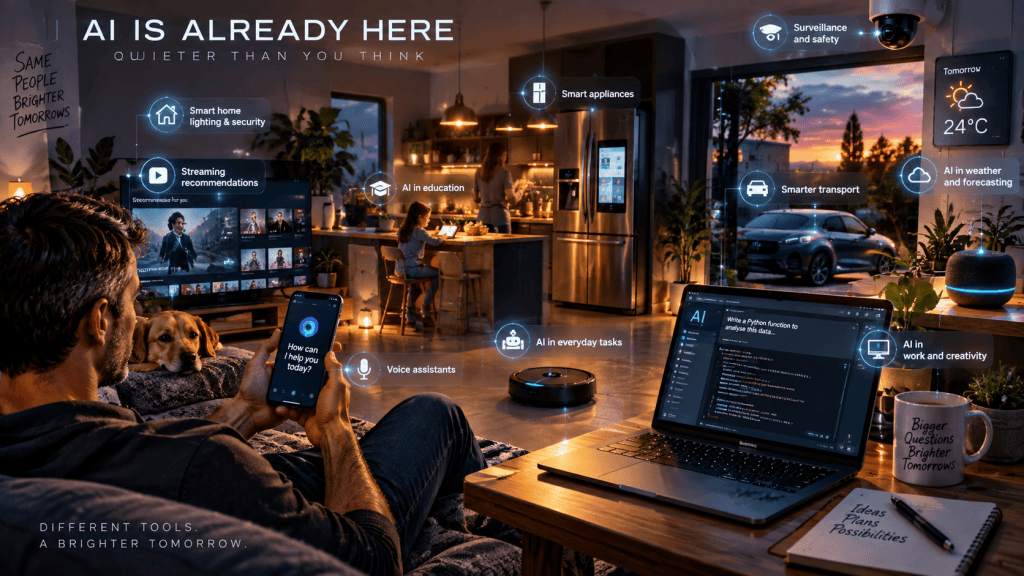
AI is everywhere. Your phone. Your PC. Your fridge, your microwave. I am sure the bottle of water next to me will soon have AI.
AI is the latest marketing buzzword, nothing more.
At least, that is sometimes how it feels.
Almost every new piece of technology seems to have the letters AI attached to it. AI-powered phones, AI-powered televisions, AI-powered cars, AI-powered appliances — even products that were doing essentially the same thing a few years ago without anyone calling them intelligent.
But behind the marketing hype is something very real.
Artificial intelligence has quietly become part of our everyday lives, often without us even noticing it. When your phone improves a photograph, predicts the next word in a message, filters spam, recognises your voice or recommends the fastest route home, some form of AI or machine learning may be involved. Streaming services use algorithms to work out what you might want to watch next. Banks use automated systems to detect unusual transactions. Online stores predict what you might buy. Search engines decide which information is most relevant to you.
And increasingly, AI isn’t simply analysing information. It can create it.
It can write text, generate images, compose music, translate languages, write computer code and hold remarkably natural conversations. That is the part of AI that has suddenly captured the world’s attention, but it represents only one branch of a much larger field.
The interesting question, then, isn’t whether AI is coming.
It’s already here.
The real questions are what we choose to do with it, how much control we are prepared to give it, and whether we understand the technology well enough to decide where it belongs in our lives.
Because somewhere between “AI is going to change the world” and “AI is just another marketing gimmick” lies a much more interesting reality.
Will AI take over our lives?
Probably — but not in the way science fiction would have us believe.
We are unlikely to wake up tomorrow morning to discover that the toaster has joined forces with the microwave and declared war on humanity. The more realistic concern is much quieter.
AI will increasingly make decisions for us.
It will decide what news we see, what music we hear, which advertisements appear on our screens and which route we take to work. It may help decide whether we qualify for a loan, identify illnesses, screen job applications and recommend what we should buy next.
Some of this is incredibly useful. Some of it should make us stop and think.
The danger isn’t necessarily that AI suddenly decides to take control. It is that we gradually hand control to it because it is convenient.
AI can be an extraordinary tool, but a tool should help us make better decisions — not remove our need to make them.
Perhaps the question isn’t “Will AI take over our lives?”
Perhaps it is:
“How much of our lives are we willing to give it?”
Have We Just Reached AGI?
For decades, Artificial General Intelligence — AGI — has been the finish line: an AI capable of tackling a broad range of intellectual tasks rather than being exceptionally good at one narrow job.
And suddenly, that finish line may be getting very close.
With the September 2026 release of GPT-6 Astra, OpenAI president Greg Brockman said that, by his personal definition, he believes we are there. However, that distinction is important: OpenAI’s formal announcement calls Astra a “new generation of intelligence” rather than officially declaring that AGI has been achieved.
The numbers certainly explain the excitement. OpenAI reports that Astra reached 99.9% on ARC-AGI-3, achieved 98% on FrontierMath Tier 4, and can autonomously operate computers, browse the web, write software and perform complicated professional tasks.
But does that make it AGI?
That depends entirely on what we mean by AGI — and there still isn’t a universally accepted test for it. Passing extraordinary benchmarks isn’t necessarily the same thing as possessing human-like general intelligence.
Perhaps history won’t give us a single dramatic moment when somebody flicks a switch and announces:
“AGI has arrived.”
Humanising AI — How Old Is It, Really?
One of the problems we have when talking about AI is that we tend to compare it with adult human intelligence.
Perhaps that’s the wrong comparison.
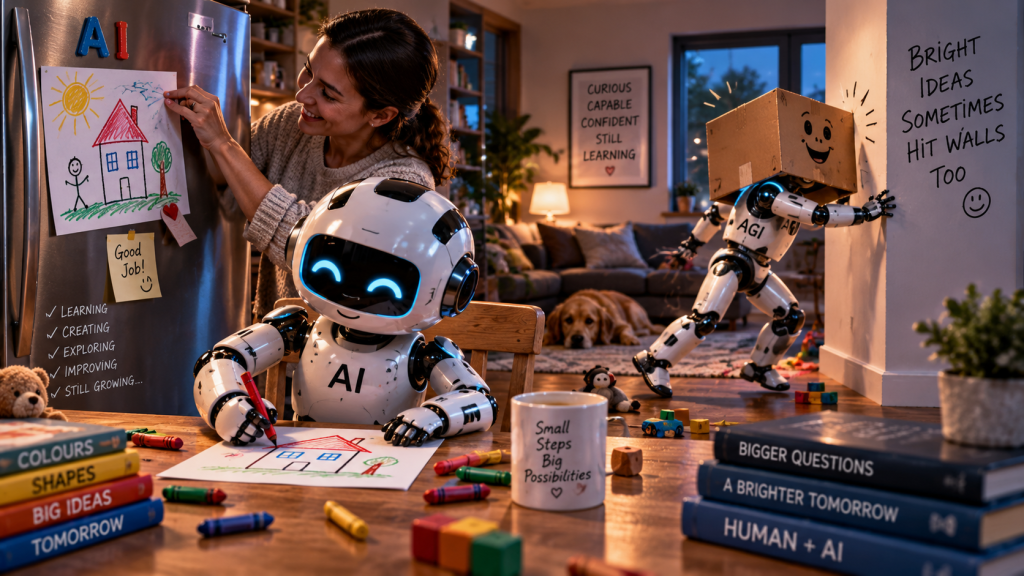
If we humanised today’s AI, I would argue that in some ways it resembles a three-year-old child with an enormous library and a very strange education.
The three-year-old draws a house. It’s a square with a triangle on top, the windows are different sizes and the chimney appears to be floating in mid-air.
We look at it and say:
“That’s amazing!”
Then we proudly stick it on the fridge.
AI has gone through much the same experience. We watched early systems generate slightly deformed faces, nonsensical text and people with seventeen fingers and thought it was extraordinary — because, technologically, it was.
The problem is that our three-year-old grew up remarkably quickly.
Modern AI can write software, analyse documents, generate realistic images, compose music and solve problems that would challenge many adults. In particular areas, it can perform at an expert level.
But then it will confidently make an absolutely ridiculous mistake.
And that’s where AGI might be thought of as our five-year-old.
Our five-year-old comes home from school with an outstanding result on their spelling test. They’re reading ahead of their class. They solve a maths problem we weren’t expecting them to understand.
We proudly announce:
“This kid is a genius.”
Five minutes later, the newly proclaimed genius puts a cardboard box over their head, runs across the lounge room and walks directly into a wall.
That isn’t actually a bad analogy for where advanced AI is heading.
The strange thing about machine intelligence is that its abilities don’t develop evenly like ours do. An AI can potentially demonstrate something approaching postgraduate-level ability in one task while making a mistake elsewhere that seems unbelievably basic.
So assigning AI a literal human age doesn’t really work. But as a metaphor, I would put today’s AI somewhere around three to five years old, with emerging AGI perhaps around five to seven.
Except this child has read more books than any human ever could, speaks dozens of languages, can work incredibly quickly and never needs to sleep.
And it is still growing up.
That may be both the most exciting — and the most important — thing to remember about AI.
AI Isn’t One Big Machine
There is one final misconception worth clearing up.
When we talk about “AI”, it is very easy to imagine one enormous intelligence sitting somewhere in a data centre, quietly learning about humanity.
It doesn’t work like that.
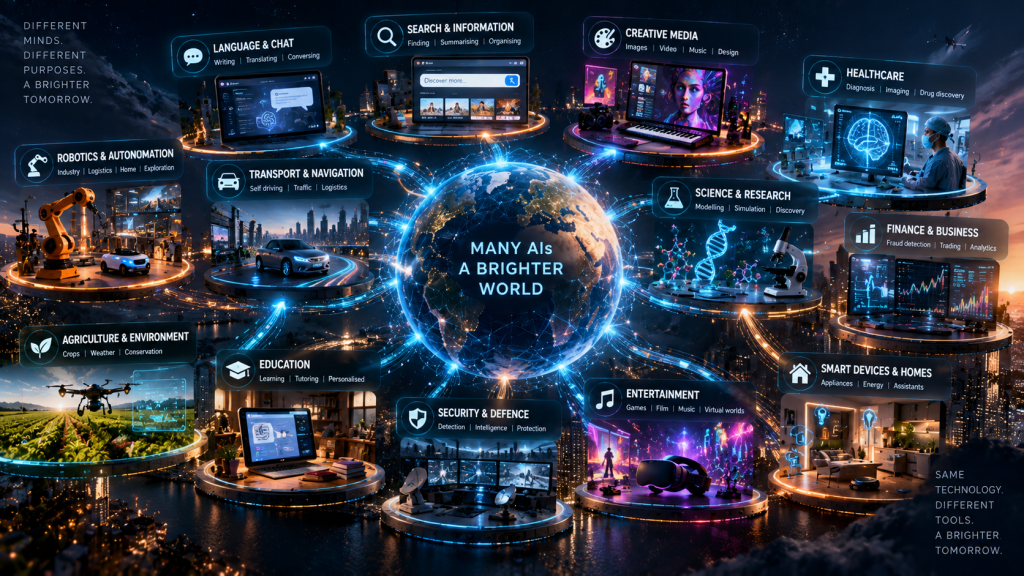
AI is really a huge collection of different technologies and tools, built by different companies, universities, governments, researchers and open-source communities around the world.
ChatGPT is one system. Google’s Gemini is another. Anthropic develops Claude. Meta develops its own AI models. Microsoft, Apple, Amazon and countless smaller companies are building different systems for different purposes.
Then there are thousands of less obvious examples.
AI helps recognise objects in photographs. Other systems detect fraud. Some predict the weather, analyse medical scans, translate languages, control robots, recommend music, identify manufacturing defects or help autonomous vehicles understand the road around them.
They aren’t all connected.
They don’t share a single mind.
And there isn’t some giant “AI” sitting behind the internet controlling all of them.
Perhaps the easiest way to understand AI is to think about electricity.
Your television, refrigerator, computer and washing machine all use electricity, but we don’t think of them as one enormous electrical machine. Electricity is the enabling technology; each device uses it differently.
AI is becoming much the same.
It is a toolbox — and increasingly, a technology layer that can be built into almost anything.
That distinction becomes particularly important when we start talking about AGI. If somebody eventually creates genuine Artificial General Intelligence, it doesn’t mean that every AI suddenly becomes intelligent. Your fridge isn’t going to wake up because somebody in a data centre created AGI.
And perhaps that’s the most important message to take away from all of this.
AI isn’t a creature. It isn’t a single machine. And it isn’t one intelligence.
It is something humans are building, piece by piece, tool by tool.
The machines may indeed be rising.
We’re still the ones building them.

